The Nuts & Bolts of Integrating
In order to make a clear, effective argument, you need to make sure to distinguish between your ideas and the ideas that come from your sources. A reader should always know when you are speaking and when your source is speaking. Once you've decided whether to paraphrase, summarize, or quote from a source, you should make sure your source material is clearly integrated into your paper.
When you are using sources in a paper, it’s important to keep your readers focused on what you are saying about the sources rather than on the sources themselves. A useful way to keep your paper focused is to begin each paragraph of your paper with a topic sentence that sets up the point of that paragraph in your own words rather than beginning with a quotation or an idea from a source. Even when you are summarizing source material to provide background for your argument, you should make it clear what that summary is doing for your argument by introducing the paragraph with a sentence in your own voice.
Example
If you were summarizing part of Michael Sandel’s article “The Case Against Perfection” for an essay about his argument, you could begin with a sentence like this to let your reader know why they need this summary:
In order to understand why genetic enhancement could actually have different effects than those Sandel suggests, it’s important to first understand his main claims.
If you were analyzing Michael Sandel’s argument and arguing that parts of it are not convincing, you might begin with a topic sentence like this:
Sandel’s claim that widespread genetic enhancement would lead to a decrease in social solidarity is flawed because he does not acknowledge that society already lacks solidarity.
In both of these examples, the topic sentence helps the reader see what the author of the paper is doing with Sandel’s arguments rather than simply summarizing those arguments.
Make sure that every time you use material from a source, you introduce it in your own words and follow it with your own analysis or discussion so that your readers understand what purpose the material is serving in your essay. You should always make it clear where your ideas end and the source's ideas begin. Your paper should never contain a paragraph that is solely based on a source without any commentary from you.
Every quotation you use in your paper should be introduced with a sentence of your own that alerts the reader to your reason for using the quotation. You should then follow the quotation with your own discussion so that your readers understand why you have quoted from the source and what you want them to take away from the quotation. Your paper should clearly focus on your argument, and your readers need to know how each source helps to develop that argument.
Example
In her Exposé essay about the composer Glenn Gould, Lucy Caplan creates clear boundaries between her own voice and the voices of her sources. In the following paragraph, she introduces the theories of two music critics, summarizing their debate in her own words and then following it with her own idea. Caplan’s ideas are in bold; note that she begins and ends the paragraph with her own discussion of the sources rather than letting the source material take over the paragraph.
The question of how to interpret music of the past is a matter of perpetual controversy.1 Should performers play in a way that recreates the music as the composer would have heard it, or should they adjust to modern conventions? One point of view, represented by longtime New Yorker music critic Andrew Porter, advocates what is known as performance practice, a style based on the premise that the most valuable performances aim to recreate, as exactly as possible, the sounds the composer would have heard (160).2 According to this theory, musicians should follow a composer's textual directions about tempo, dynamics and other details of performance; in this sense, performance practice aims for what may be called "historical fidelity," in which an ideal musical performance attempts to recreate, as authentically as possible, the very sounds a composer intended. But other critics, such as musicologist Richard Taruskin, counter that "authentic" performances do not necessarily have any greater aesthetic value (74).3 Since musical performance necessarily involves a degree of interpretation on the part of the musician, he argues, performers should be able to interpret music freely, without feeling bound to strict conventions. The debate between these two points of view remains unresolved; indeed, it has only intensified as the music at the center of the debate moves further into the past. The debate over historical fidelity, in other words, becomes more difficult to resolve as modern musical traditions become less similar to its historical predecessors.4
Caplan does the following to frame her source material:
- Caplan's topic sentence sets up the debate that she is going to discuss.
- In the third sentence, Caplan summarizes Andrew Porter's point of view and cites her source.
- Caplan begins her summary of Richard Taruskin's point of view in the fifth sentence of the paragraph. She cites her source at the end of the sentence.
- In the final two sentences of the paragraph, Caplan makes it clear that she is moving beyond her sources to state her own idea.
Later in her essay, Caplan quotes both Porter and Taruskin. Each time she quotes from one of these sources, she integrates the quotation into a sentence of her own so that her readers will know who is speaking and also what the quotation adds to her argument. If Caplan had simply reproduced the quotations without constructing her own sentences, her readers wouldn't know why she was sharing the quotations with them.
In the example below, Caplan embeds the quotation from Porter in a sentence that clearly contrasts Porter's view with Taruskin's view. In the next sentences, she expands her discussion of Taruskin's views. She finishes the paragraph by explaining what these quotations illustrate about the performance practice debate.
Whereas Porter claimed in his New Yorker review that “Beethoven’s music rang out…more beautifully…on the early instruments,” Taruskin suggests that performance practice may yield musicians who passively rather than actively read musical compositions. In a passive interpretation, he writes, “the notes and rests are presented with complete accuracy and an equally complete neutrality” (72). Early music, in this context, can become “a positivistic purgatory, literalistic and dehumanizing, a thing of taboos and shalt-nots” (Taruskin 76). These terms may be extreme, but they do give an idea of the intensity of the performance practice debate; Taruskin’s concerns were shared to some extent by many critics of performance practice.
A signal phrase is an introductory clause that signals to the reader a shift in point of view from you to your source. The appropriate use of signal phrases varies from discipline to discipline. Writers in the humanities often signal a quotation or paraphrase with the author's name (as in "Chen argues…" or "Cole notes…"). The choice of verb in a signal phrase can give your readers information about the disposition of the source. For example, the phrase "Sandel argues" signals that Sandel is making a claim, while the phrase "Sandel notes" signals a more neutral reporting of information.
Social scientists may use signal phrases more sparingly, introducing the names of authors or researchers when they want to place particular emphasis on the credibility of the source or to draw attention to the importance of the source author. Pay close attention to how the authors you read in your courses use signal phrases; these models will provide you with clues about the conventions of a particular discipline. When in doubt, ask your instructor whether you should name authors in the body of your paper rather than leaving that information for your citations.
Here are some examples of signal phrases you might use:
Allen argues
Sandel notes
Lewis confirms
Gates emphasizes
Wilson contends
Patterson acknowledges
Mukherjee observes
Carpio suggests
Banaji claims
Example
In her essay about alienation among McDonald's workers, Joanna Li quotes from and paraphrases a book by Robin Leidner. In the selection below, Li uses signal phrases to indicate when she is paraphrasing from and quoting from Leidner's book.
Quick, standard exchanges, Leidner reveals, had the added benefit of protecting workers from intrusive or uncomfortable personal conversations (146). Given the long lines and customer expectation for speedy service, highly personalized conversations were often desired by neither party and workers preferred customers who were "ready to give their order" (Leidner 143). As Leidner notes, McDonald's management valued a friendly atmosphere but emphasized speed as their first priority; routines helped workers who "prided themselves on their speedy service" (143) to stay efficient and professional.
By saying "Leidner reveals," Li signals that the idea that follows is Leidner's idea. The second signal phrase, "Leidner notes," signals to the reader that the idea and the quotation in this sentence are Leidner's ideas.
When you introduce a quotation with a signal phrase, that quotation becomes part of your own sentence. It's important, then, to make sure that the sentence is grammatically correct. If you are having trouble molding the grammar of the quotation to the grammar of your paper, you can use brackets to help you. In the following sentence from Peter Bozzo's Exposé essay about the documentary film Paradise Lost: The Child Murders at Robin Hood Hills, Bozzo adds brackets to make the quotation fit grammatically into his own sentence.
Example
The filmmakers highlight Echols's vanity by suggesting that it consumed him even when issues of his guilt or innocence and life or death were at stake; in actuality, however, his actions may have represented a typical response to correct for what Echols refers to in the second film as a "haircut [that] was actually given to me about five minutes before the hearing by a woman in the back room with a pair of plastic scissors."
In the original quotation, Echols says "a haircut was actually given to me about five minutes before the hearing…" In order to make his sentence read smoothly, Bozzo has added the "that" in brackets to fit the grammar of his sentence.
Be careful not to overuse brackets in your paper. If you find yourself needing to change most words in a quotation to bracketed substitutes, you should reconsider either the quotation or your own sentence.
If you're quoting from a long passage and you don't want to use the whole passage, you can omit parts of it by using the ellipsis mark. The ellipsis is three periods, with spaces between them, and indicates to your reader that words have been omitted. Remember that you are obligated to represent a quotation accurately and that you should only omit words if those words do not change the meaning of the quotation. You don't need to use the ellipsis at the beginning or the end of a quotation since it will be clear to your reader that you have not quoted the entire source.
Example
Le Coney and Trodd explain that
the frontier loomed large as early as 1960, when John F. Kennedy's Democratic Party Nomination acceptance speech observed: "From the lands that stretch 3000 miles behind me, the pioneers of old gave up their safety, their comfort and sometimes their lives to build a new world here in the West . . . But the problems are not all solved and the battles are not all won, and we stand today on the edge of a new frontier."
Be careful not to allow your use of ellipses to alter the meaning of a passage. If you omit too much from a quotation you risk misrepresenting the original source.
Block quotations should be used when the quotation you have chosen to include is too long to go into the body of your paragraph. When you use a block quotation in MLA, APA, or Chicago style, you should introduce the quotation with a sentence of your own that sets up the context for the quotation. You should also follow a block quotation with a sentence or more of your own that explains what you want your reader to understand about the quotation. You do not need to put quotation marks around the block quotation because the indentation shows readers that this is a quotation.
MLA Block Quotations
If you are using the MLA citation style you should use block quotations for any quotation that is more than four typed lines of prose or three lines of poetry. In the MLA style, block quotations should either be introduced with a sentence that ends with a colon or with punctuation that allows you to connect the quotation with the rest of your sentence. The quotation should be indented one inch from the left margin. You do not need to use quotation marks around the quotation. The citation (name and/or page number if this information does not appear in the body of the paper) comes after the final punctuation in the quotation. No additional punctuation follows.
Examples
Block quotation introduced by a sentence ending with a colon
Image version
Full text
The author investigated the different tours that Harvard students offer visitors and described her experience with Crimson Key in an article for Harvard Magazine:
At no point in our official travels did anyone scream, which I suppose I should have expected. Crimson Key focuses, above all, on accuracy. The training handbook for the guides clarifies confusing details and corrects popular myths. For instance, one rule states, “The Polaroid Story is FALSE” (referring to the belief that the Science Center was designed to look like a Polaroid camera). “We have been explicitly asked not to tell this story. DO NOT MENTION IT.” (Lasky)
Block quotation introduced by sentence that continues into the quotation
Image version
Full text
The author pulls the curtain back on the official Harvard tour, explaining that
At no point in our official travels did anyone scream, which I suppose I should have expected. Crimson Key focuses, above all, on accuracy. The training handbook for the guides clarifies confusing details and corrects popular myths. For instance, one rule states, “The Polaroid Story is FALSE” (referring to the belief that the Science Center was designed to look like a Polaroid camera). “We have been explicitly asked not to tell this story. DO NOT MENTION IT.” (Lasky)
APA Block Quotations
If you are using the APA citation style, you should use block quotations for any quotation that is 40 or more words, and you should indent the passage one-half inch from the left margin. Citations should come after the final punctuation of the quotation, and you should not include any punctuation after the citation.
Block quotation introduced by a sentence ending with a colon
Image version
Full text
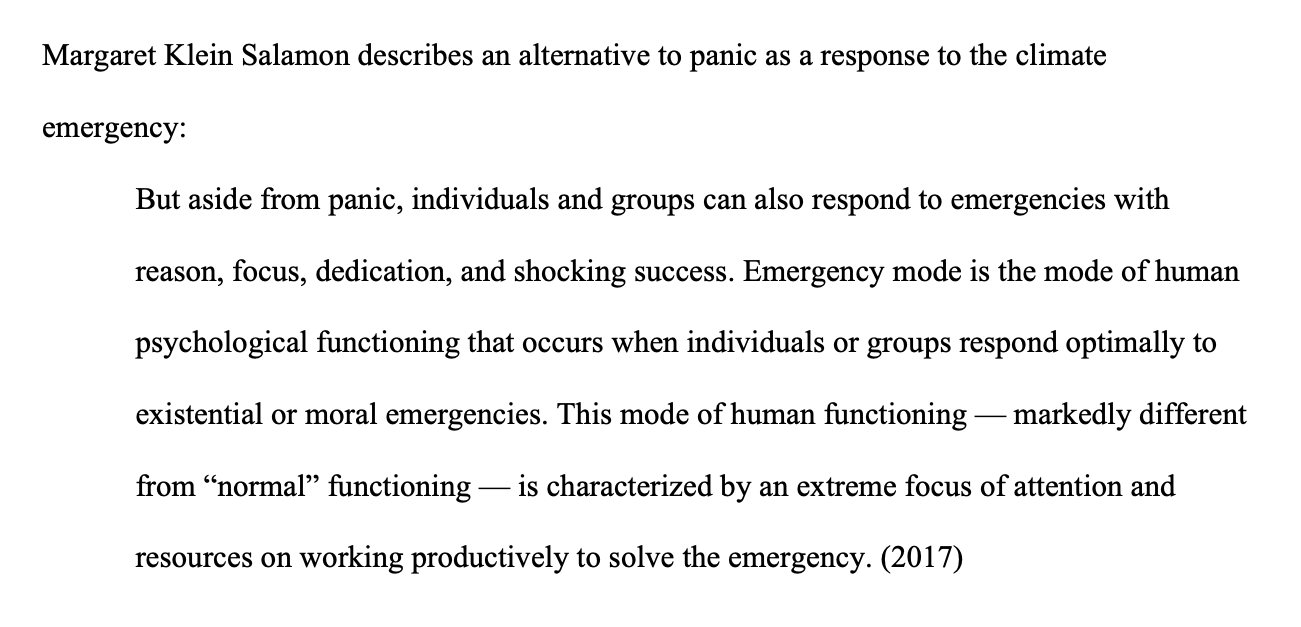
Margaret Klein Salamon describes an alternative to panic as a response to the climate emergency:
But aside from panic, individuals and groups can also respond to emergencies with reason, focus, dedication, and shocking success. Emergency mode is the mode of human psychological functioning that occurs when individuals or groups respond optimally to existential or moral emergencies. This mode of human functioning — markedly different from “normal” functioning — is characterized by an extreme focus of attention and resources on working productively to solve the emergency. (2017)
Block quotation introduced by sentence that continues into the quotation
Image version
Full text
Margaret Klein Salamon explains that
aside from panic, individuals and groups can also respond to emergencies with reason, focus, dedication, and shocking success. Emergency mode is the mode of human psychological functioning that occurs when individuals or groups respond optimally to existential or moral emergencies. This mode of human functioning — markedly different from “normal” functioning — is characterized by an extreme focus of attention and resources on working productively to solve the emergency. (2017)
Chicago Block Quotations
If you are using the Chicago citation style, you can decide whether to set off your block quotations or to run them into the body of your essay. If you do use block quotations in Chicago style, indent the quoted passage one-half inch from the left margin.
Don’t float the quotation! Follow quotation with your analysis of the quotation.
When you quote from any source, you should always be showing your readers how you are using the quotation in your paper by introducing it with your own sentence and following it with your own discussion. Here’s an example:
In her Expos essay about composer Glenn Gould, Lucy Caplan uses a block quotation from an article by music critic Andrew Porter. Caplan introduces her block quotation with a sentence of her own that provides the context for the quotation. This sentence ends with a colon.
Image version
Full text
Andrew Porter, in a 1986 New Yorker concert review, compared two performances of a Beethoven cello sonata, one of which took place on period instruments and one on modern instruments:
Polite discussion followed [the performances], but it was apparent to anyone with ears that Beethoven’s music rang out more bravely, more beautifully, and in better balance on the early instruments. In that direct comparison, the modernized cello sounded chocolate-coated and the little Yamaha piano loud and coarse. (142)
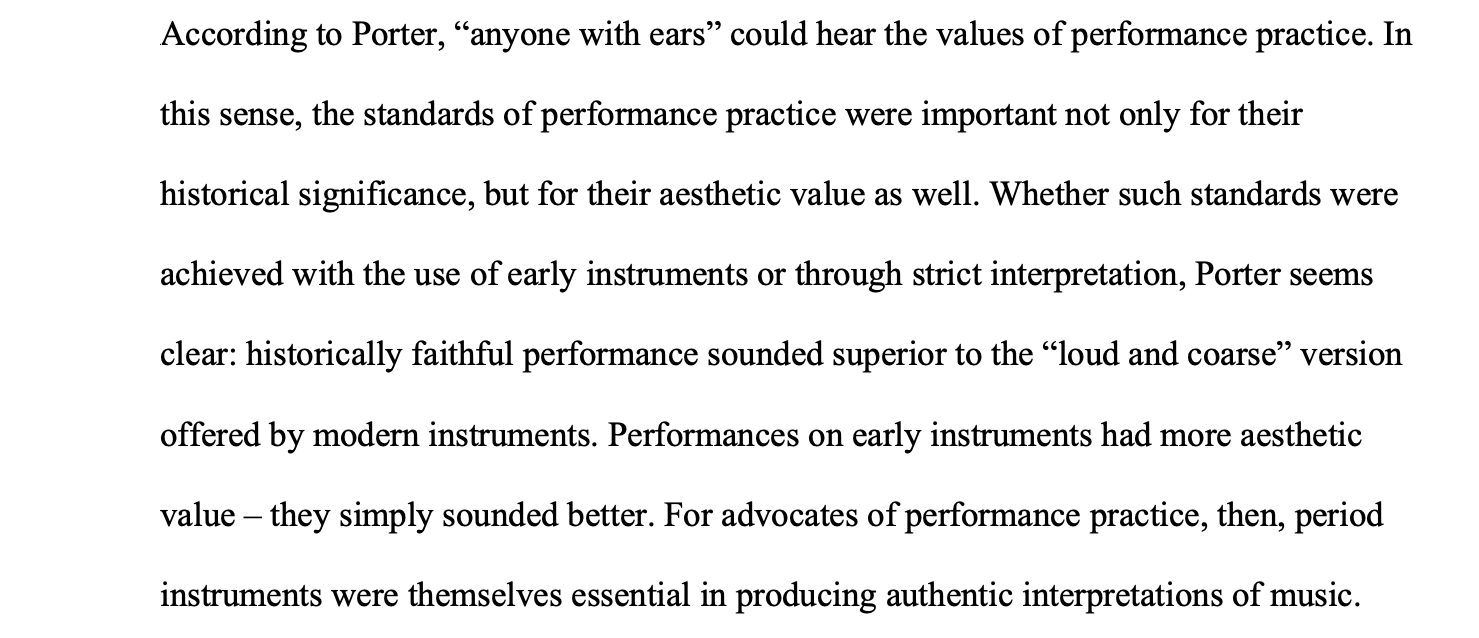
Caplan follows the block quotation with an entire paragraph of analysis in which she makes it clear to her readers how Porter's words add to her argument.
Image version
Text example
According to Porter, “anyone with ears” could hear the values of performance practice. In this sense, the standards of performance practice were important not only for their historical significance, but for their aesthetic value as well. Whether such standards were achieved with the use of early instruments or through strict interpretation, Porter seems clear: historically faithful performance sounded superior to the “loud and coarse” version offered by modern instruments. Performances on early instruments had more aesthetic value – they simply sounded better. For advocates of performance practice, then, period instruments were themselves essential in producing authentic interpretations of music.
For MLA, APA, and Chicago, you should use double quotation marks when you quote material from a source. If you are also quoting passages from that source that were quoted in the original source, use single quotation marks to indicate that the original source contained the quotation.
If you are using a block quote, then you should use double quotation marks around the quoted material and no quotation marks around the block quote.
Example
In her review of Joan Didion’s book Let Me Tell You What I Mean, Maia Silber quotes several passages from Didion’s book. If you were quoting from Silber’s review and you included those passages, you would need to indicate that the quoted language comes from Didion’s book rather than from Silber. In that case, you would use single quotation marks to indicate the quoted material:
Silber writes that “Didion begins in her familiarly sardonic tone, observing that ‘the wives had pretty dresses, and everyone liked Las Vegas.’”
In the system of punctuation used in the United States, periods and commas go inside quotation marks except when you use in-text citations. In those cases, periods and commas go outside the quotation marks after the parenthetical citation.
Example
Punctuation inside the quotation marks
In his review of the performance, Owen Torrey described the moment that the musician “leaned back as the noise towered above, the crowd moving behind him in a moment of pure sound.”1
---------------------------------------
1. Owen Torrey, “Alex G Kept the Mystery Alive in Toronto,” Exclaim!, November 6, 2022, https://exclaim.ca/music/article/alex_g_concert_review_toronto_history.
Because this sentence contains a footnote rather than an in-text citation, the period goes inside the quotation marks.
Punctuation outside the quotation marks
Batkin argues that “what is needed to shore up essential protections for low-income people is a principle behind wealth-based equal process” (2021, p.1553).
Because this sentence includes an in-text citation, the period goes outside the quotation marks.
Exclamation points and question marks go inside the quotation marks when they are part of the quotation, and outside when they are part of your own sentence that contains the quotation. With in-text citations, the question mark or exclamation point goes inside the quotation if it is part of that quotation, and a period follows the parenthetical citation.
Example:
Inside
In an interview, Peter Singer expressed concern about whether he should have spent so much time writing about his family history, saying, “And I still have that feeling a little bit. Which of my works have done the most good?” (Gross).
Outside
But what are we to make of Harding's admonition to "write while you can no matter the sacrifice"?1
Colons and semicolons go outside quotation marks unless they are part of the quotation
Example
Sandel argues that “the problem is not the drift to mechanism but the drive to mastery”; in other words, he is more concerned about the implications of trying to control nature.
Because the semi-colon was introduced by the author of the sentence and not by Sandel, it appears outside of the quotation marks.
Use the Latin word sic to indicate that a grammatical or spelling error appears in the source that you are quoting and is not your error. Sic should be enclosed in brackets within the quotation. APA style and Chicago style require sic to be italicized; MLA style does not.
Example
In his letter to the editor, Harding admonishes his audience to "rite [sic] while you can, no matter the sacrifice" (23).